<?xml version="1.0" encoding="UTF-8"?>
<rss version="2.0"
	xmlns:content="http://purl.org/rss/1.0/modules/content/"
	xmlns:wfw="http://wellformedweb.org/CommentAPI/"
	xmlns:dc="http://purl.org/dc/elements/1.1/"
	xmlns:atom="http://www.w3.org/2005/Atom"
	xmlns:sy="http://purl.org/rss/1.0/modules/syndication/"
	xmlns:slash="http://purl.org/rss/1.0/modules/slash/"
	>

<channel>
	<title>Hinds Instruments - Hinds Instruments</title>
	<atom:link href="http://www.hindsinstruments.com/feed/" rel="self" type="application/rss+xml" />
	<link>http://www.hindsinstruments.com</link>
	<description>Enlightened Measurement Technologies</description>
	<lastBuildDate>Fri, 20 Jan 2012 15:24:54 +0000</lastBuildDate>
	<generator>http://wordpress.org/?v=2.9.1</generator>
	<language>en</language>
	<sy:updatePeriod>hourly</sy:updatePeriod>
	<sy:updateFrequency>1</sy:updateFrequency>
			<item>
		<title>Hinds Photoelastic Modulators with Advanced Thermal Control</title>
		<link><br />
<b>Warning</b>:  call_user_func_array() [<a href='function.call-user-func-array'>function.call-user-func-array</a>]: First argument is expected to be a valid callback, 'resers_filter_feed_permalinks' was given in <b>/usr/home/hindsinstr/domains/hindsinstruments.com/public_html/wp-includes/plugin.php</b> on line <b>166</b><br />
</link>
		<comments>http://www.hindsinstruments.com/2012/01/hinds-photoelastic-modulators-with-advanced-thermal-control/#comments</comments>
		<pubDate>Fri, 20 Jan 2012 15:24:54 +0000</pubDate>
		<dc:creator>sarah</dc:creator>
				<category><![CDATA[News]]></category>

		<guid isPermaLink="false">/?p=3722</guid>
		<description><![CDATA[Hinds Instruments, Inc. announces the PEM-ATCTM, a photoelastic modulator with advanced thermal control.  This new PEM design offers long term stability and freedom from drift caused by ambient temperature variations.
The PEM-ATC is equipped with a proprietary PID controller, internal heating and a temperature sensor.  Through the use of heater operated PID feedback control, [...]]]></description>
			<content:encoded><![CDATA[<p>Hinds Instruments, Inc. announces the PEM-ATC<sup>TM</sup>, a <a href="http://www.hindsinstruments.com/products/photoelastic-modulators/pem-atc/">photoelastic modulator</a> with advanced thermal control.  This new PEM design offers long term stability and freedom from drift caused by ambient temperature variations.</p>
<p>The PEM-ATC is equipped with a proprietary PID controller, internal heating and a temperature sensor.  Through the use of heater operated PID feedback control, the interior of the PEM optical head is held at a constant 90°F or 32°C, even when ambient temperatures are fluctuating.</p>
<p>Figure 1, below, demonstrates the stability of the PEM signal when ambient temperatures are changing.  With temperature fluctuations from 66° to 72°F the PEM signal standard deviation was only 0.05% of the normalized signal (R/DC) over 60 hours.</p>
<p><a href="http://www.hindsinstruments.com/wp-content/uploads/60-hour-graph.png"><img src="http://www.hindsinstruments.com/wp-content/uploads/60-hour-graph.png" alt="PEM-ATC temp stability" title="60 hour graph" width="520" height="205" class="alignleft size-full wp-image-3669" /></a></p>
<p><em>Figure 1. PEM signal with fluctuating ambient temperature.</em></p>
<p>Figure 2, below, demonstrates the stability of the PEM-ATC.  The blue line represents 3 hours of PEM signals without thermal control.  Note the upward, relatively linear drift of the signal.  Traditional approaches for addressing this include making periodic offset corrections. The red line represents 3 hours of PEM data with Advanced Thermal Control.  With this advanced PEM design there is essentially no drift over the three hour time frame shown on this graph.</p>
<p><a href="http://www.hindsinstruments.com/wp-content/uploads/3-hour-graph.jpg"><img src="http://www.hindsinstruments.com/wp-content/uploads/3-hour-graph.jpg" alt="" title="3 hour graph" width="520" height="291" class="alignleft size-full wp-image-3753" /></a></p>
<p><em>Figure 2. Percent change of PEM signals over time.  Note the most stable signal in red is data taken with the PEM Advanced Thermal Control.</em></p>
<p>The ATC option is currently available for the I/FS 50 model (fused silica) but available for other models on request.  For PEM applications requiring high sensitivity and thermal stability, this new option provides a cost-effective solution with little impact on experimental footprint.</p>
<p>Hinds Instruments, Inc. is a world leader in developing and supplying <a href="http://www.hindsinstruments.com/">polarization measurement technology</a> for a broad range of applications. With 40+ years of polarization modulation experience, Hinds Instruments solutions are proven tools for research applications as well as metrology in the lab or fab. Hinds’ family of products includes modulators, Stokes polarimeters, Mueller matrix polarimeters, MOKE measurement systems and Exicor® birefringence measurement systems. For more information, please contact <a href="http://www.hindsinstruments.com/contact-us/">Hinds Instruments</a>.</p>
]]></content:encoded>
			<wfw:commentRss>http://www.hindsinstruments.com/2012/01/hinds-photoelastic-modulators-with-advanced-thermal-control/feed/</wfw:commentRss>
		<slash:comments>0</slash:comments>
		</item>
		<item>
		<title>Residual Stress Birefringence in Optical Materials</title>
		<link><br />
<b>Warning</b>:  call_user_func_array() [<a href='function.call-user-func-array'>function.call-user-func-array</a>]: First argument is expected to be a valid callback, 'resers_filter_feed_permalinks' was given in <b>/usr/home/hindsinstr/domains/hindsinstruments.com/public_html/wp-includes/plugin.php</b> on line <b>166</b><br />
</link>
		<comments>http://www.hindsinstruments.com/2011/11/residual-stress-birefringence-in-optical-materials/#comments</comments>
		<pubDate>Wed, 30 Nov 2011 20:11:17 +0000</pubDate>
		<dc:creator>sarah</dc:creator>
				<category><![CDATA[News]]></category>

		<guid isPermaLink="false">/?p=3572</guid>
		<description><![CDATA[
Understanding birefringence provides a roadmap for improving the quality of optical parts.

By Douglas C. Mark, Hinds Instruments, Inc.

Summary: Understanding the residual stress birefringence characteristics of both individual components and bulk materials is critical for researchers, quality control professionals and factory managers responsible for products ranging from precision optics to high volume consumer devices.
Residual stress in [...]]]></description>
			<content:encoded><![CDATA[<div>
<h2>Understanding birefringence provides a roadmap for improving the quality of optical parts.</h2>
<p></p>
<p>By Douglas C. Mark, Hinds Instruments, Inc.</p>
<p></p>
<p>Summary: Understanding the residual stress birefringence characteristics of both individual components and bulk materials is critical for researchers, quality control professionals and factory managers responsible for products ranging from precision optics to high volume consumer devices.</p>
<p>Residual stress in optical transparent materials often manifests itself as a polarization-dependent optical property, such as linear birefringence. <a href="http://en.wikipedia.org/wiki/Birefringence" target="_blank">Birefringence</a>, or the double refraction of light, is a common natural characteristic of many crystals and other anisotropic materials such as calcite and mica. Isotropic materials such as fused silica, commercial glass (including both float glass and fusion glass) and many plastics have a uniform index of refraction in all directions and do not exhibit native birefringence. However, whenever mechanical stress is applied to isotropic materials, residual birefringence is generated. This birefringence is linearly-proportional to the stress in the material. If the material thickness and stress-optic coefficient of the material are known, the birefringence can be used to calculate the residual stress, which is typically stated in units of pressure, such as MPa or psi. Because the relationship is linear, birefringence magnitude can be substituted for actual stress (i.e. high birefringence = high residual stress).</p>
<p>Many factors contribute to birefringence in optical materials. For example, any of the following conditions can cause stress birefringence: applied external pressure (from mounting hardware, etc.); primary manufacturing processes (material process variables); secondary manufacturing processes (grinding, cutting, heating, bending, etc.); handling and impact damage (chips, cracks, scratches); bubbles or inclusions in the material; process-induced temperature differentials; injection pressures in plastic molding processes; and the stretch rate and processing temperature in plastic film production. Observing and measuring birefringence in manufactured parts can reveal a lot about how the part may perform in an application. For example, high stress in thin display glass may result in poor material yield due to fracturing during processing or handling. In some cases, high stress can degrade the optical performance of finished parts (e.g., excessive light bleed in polarization-dependent thin glass display applications). In precision polarization optics, high stress and high birefringence can disrupt the light passing through the optic and change the polarization state of the light. In lithographic applications, this can lead to poor quality images.</p>
<p>Birefringence can be observed and measured in many ways. Extremely high levels of birefringence can be observed with the naked eye. Observation is improved by the use of a <a href="http://gemologyproject.com/wiki/index.php?title=Polariscope" target="_blank">polariscope</a>, in which a sample is placed between two crossed polarizers and a backlight. In this arrangement, color shifts can be observed that are proportional to the magnitude of the birefringence in the sample. The polariscope is a good qualitative solution for observing large magnitude stress patterns in optical materials. It is commonly used in mineralogy to identify specific gems and minerals. It requires a skilled user who understands the relationship between observed color shifts and birefringence, i.e., optical retardation per unit of thickness (typically, nm/cm). In addition, an accurate observation of color shifts requires a precise orientation of the sample between the polarizers. This technique is generally subjective, and relies heavily on the trained observation skills of the individual operator. It also relies on the operator’s ability to accurately and consistently apply other reference tools, such as a <a href="http://en.wikipedia.org/wiki/Auguste_Michel-L%C3%A9vy" target="_blank">Michel-Lévy interference color chart</a>.</p>
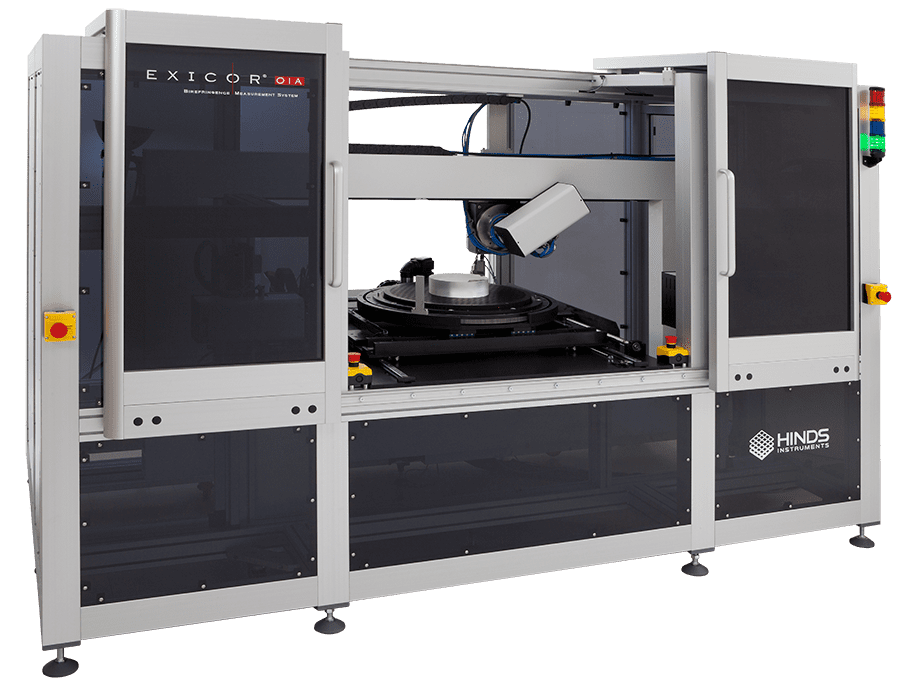
<p>By contrast, a more quantitative approach to measuring the birefringence magnitudes present in samples will provide information that is much more useful and actionable for quality control professionals and factory managers. Quantitative measurement techniques reveal actual birefringence values, which permit the development of documented QC procedures. These can include unambiguous meet/exceed/reject targets, as well as threshold values used by optical engineers developing complex optical systems. There are several ways to obtain a quantitative characterization of birefringence in a sample. One system, the Hinds Instruments Exicor® birefringence measurement system, reports birefringence magnitude (nm/cm) and fast axis orientation (°). This system is not dependent on the orientation of the sample relative to the machine, and makes precise and repeatable measurements that are orders of magnitude lower than the most highly-skilled user would be able to detect with the aid of a polariscope (0.001nm optical retardation resolution). When coupled with motion stages (as in the <a href="http://www.hindsinstruments.com/products/birefringence-measurement-systems/150-at/" target="_blank">Exicor150AT</a>), the Exicor Birefringence measurement system quickly provides a map of both the magnitude and the orientation of birefringence in a sample. Users can select system wavelengths from DUV to NIR to match the transmission characteristics of particular samples.</p>
<p>Hinds Instruments, Inc. is the world leader in developing and supplying polarization modulation technology for a broad range of applications. With 40+ years of polarization modulation experience, Hinds Instruments’ PEM-based solutions are proven tools for laboratory and research applications. Hinds’ family of products includes modulators, Stokes polarimeters, Mueller matrix polarimeters, MOKE measurement systems and Exicor® birefringence measurement systems. For more information, please contact <a href="http://www.hindsinstruments.com/contact-us/" target="_blank">Hinds Instruments</a>.</p>
</div>
]]></content:encoded>
			<wfw:commentRss>http://www.hindsinstruments.com/2011/11/residual-stress-birefringence-in-optical-materials/feed/</wfw:commentRss>
		<slash:comments>0</slash:comments>
		</item>
		<item>
		<title>Hinds Instruments Celebrates 40 Years</title>
		<link><br />
<b>Warning</b>:  call_user_func_array() [<a href='function.call-user-func-array'>function.call-user-func-array</a>]: First argument is expected to be a valid callback, 'resers_filter_feed_permalinks' was given in <b>/usr/home/hindsinstr/domains/hindsinstruments.com/public_html/wp-includes/plugin.php</b> on line <b>166</b><br />
</link>
		<comments>http://www.hindsinstruments.com/2011/11/hinds-instruments-celebrates-40-years/#comments</comments>
		<pubDate>Tue, 01 Nov 2011 17:10:29 +0000</pubDate>
		<dc:creator>sarah</dc:creator>
				<category><![CDATA[News]]></category>

		<guid isPermaLink="false">/?p=3457</guid>
		<description><![CDATA[
Many things have changed since we opened our doors 40 years ago. But one thing hasn’t changed: Your need for state-of-the-art polarization measurement solutions. From the research lab to the factory floor, in applications as diverse as chiral analysis and LCD glass measurement, Hinds Instruments has solved some of the toughest problems in polarization measurement [...]]]></description>
			<content:encoded><![CDATA[<div>
<p>Many things have changed since we opened our doors 40 years ago. But one thing hasn’t changed: Your need for state-of-the-art polarization measurement solutions. From the research lab to the factory floor, in applications as diverse as chiral analysis and LCD glass measurement, Hinds Instruments has solved some of the toughest problems in polarization measurement around the World – and in Space. No one else has the knowledge and experience to help you understand and control your application or environment with the polarization of light. <a href="http://www.hindsinstruments.com/contact-us/">Contact us</a> today to see how we can help you solve the problems you can’t see now. We‘re here to serve you both before and after your purchase and commit our best efforts to meeting your expectations so we can be around to support you for another 40 years.</p>
<p>Paul W. Hinds, President<br />
Hinds Instrument, Inc.</p>
</div>
]]></content:encoded>
			<wfw:commentRss>http://www.hindsinstruments.com/2011/11/hinds-instruments-celebrates-40-years/feed/</wfw:commentRss>
		<slash:comments>0</slash:comments>
		</item>
		<item>
		<title>Use of PEMs in Magneto Optic Kerr Effect Experiments</title>
		<link><br />
<b>Warning</b>:  call_user_func_array() [<a href='function.call-user-func-array'>function.call-user-func-array</a>]: First argument is expected to be a valid callback, 'resers_filter_feed_permalinks' was given in <b>/usr/home/hindsinstr/domains/hindsinstruments.com/public_html/wp-includes/plugin.php</b> on line <b>166</b><br />
</link>
		<comments>http://www.hindsinstruments.com/2011/10/use-of-pems-in-magneto-optic-kerr-effect-experiments/#comments</comments>
		<pubDate>Thu, 13 Oct 2011 20:36:33 +0000</pubDate>
		<dc:creator>sarah</dc:creator>
				<category><![CDATA[News]]></category>

		<guid isPermaLink="false">/?p=3412</guid>
		<description><![CDATA[Do you need to measure magneto-optic effects? Are you working with magnetic thin film storage materials?
Hinds Instruments provides two solutions: a component-based build-it-yourself package and a full turnkey system. Both of these are based on Hinds’ Instruments Photoelastic Modulator (PEM) technology.
Hinds PEMs provide increased sensitivity for MOKE measurements. In addition, Hinds Signaloc lock-in amplifiers (LIAs) and photodiode detectors (DETs) are optimized [...]]]></description>
			<content:encoded><![CDATA[<p>Do you need to measure magneto-optic effects? Are you working with magnetic thin film storage materials?</p>
<p>Hinds Instruments provides two solutions: a component-based build-it-yourself package and a full turnkey system. Both of these are based on Hinds’ Instruments Photoelastic Modulator (PEM) technology.</p>
<p>Hinds PEMs provide increased sensitivity for MOKE measurements. In addition, Hinds Signaloc lock-in amplifiers (LIAs) and photodiode detectors (DETs) are optimized for use with PEMs. This allows sensitive measurements of thin magnetic films using reflection or transmission techniques. “The beauty of the photoelastic modulation technique is that, not only does this increase signal-to-noise ratio for the detection of very small magneto-optical effects and can, in some instances, eliminate defects in polarizing devices but the detection of both fundamental and second harmonic signals that are generated are directly proportional to the Kerr (or Faraday) ellipticity and rotation, respectively. This means that these two extremely important parameters can be measured simultaneously”, according to Prof. Ron Atkinson (The Queen’s University Belfast, Professor Emeritus, <a href="http://www.hindsinstruments.com/wp-content/uploads/pem-10-MOKE.pdf">Hinds Newsletter, Fall 2001</a>). The Queen’s group reported precision typically of the order of 1 arc sec for Kerr rotation values and have, in the past, been able to detect MO signals from films that are the thickness of a single atom.</p>
<p>Hinds component-based packages contain a magnetic field compatible PEM, a light source, one or two lock-in amplifiers, a photodiode detector, and two polarizers.  Mounts and other optical components needed for bench set-up can be provided by Hinds as well.</p>
<p>When Hinds Instruments develops turnkey solutions, such as the MOKE system, the finished product is an all inclusive, user-friendly tool. Standard magnetic field densities are available from 500 Gauss to 1 Tesla. Systems with other field densities can be custom designed.</p>
<p>Hinds Instruments, Inc. is the world leader in developing and supplying polarization modulation technology for a broad range of applications. With 40+ years of polarization modulation experience, Hinds Instruments PEM-based solutions are proven tools for laboratory and research applications. Hinds’ family of products includes modulators, Stokes polarimeters, Mueller matrix polarimeters, MOKE measurement systems and Exicor <sup>®</sup> birefringence measurement systems. For more information, please contact <a href="http://www.hindsinstruments.com/contact-us/">Hinds Instruments</a>.</p>
]]></content:encoded>
			<wfw:commentRss>http://www.hindsinstruments.com/2011/10/use-of-pems-in-magneto-optic-kerr-effect-experiments/feed/</wfw:commentRss>
		<slash:comments>0</slash:comments>
		</item>
		<item>
		<title>Hinds Instruments and New York University Lab collaborate on GOALI grant</title>
		<link><br />
<b>Warning</b>:  call_user_func_array() [<a href='function.call-user-func-array'>function.call-user-func-array</a>]: First argument is expected to be a valid callback, 'resers_filter_feed_permalinks' was given in <b>/usr/home/hindsinstr/domains/hindsinstruments.com/public_html/wp-includes/plugin.php</b> on line <b>166</b><br />
</link>
		<comments>http://www.hindsinstruments.com/2011/09/hinds-instruments-and-new-york-university-lab-collaborate-on-goali-grant/#comments</comments>
		<pubDate>Tue, 20 Sep 2011 15:56:27 +0000</pubDate>
		<dc:creator>sarah</dc:creator>
				<category><![CDATA[News]]></category>

		<guid isPermaLink="false">/?p=3402</guid>
		<description><![CDATA[NYU and Hinds collaborate to develop a Mueller matrix polarimeter for chiroptical spectroscopy of crystals.


Hillsboro, Oregon, September 20, 2011 – Hinds Instruments, a leading global supplier of photoelastic modulators (PEMs), along with New York University today announced the awarding of an NSF-sponsored Grant Opportunity for Academic Liason with Industry (GOALI).   The grant is [...]]]></description>
			<content:encoded><![CDATA[<h2><strong>NYU and Hinds collaborate to develop a Mueller matrix polarimeter for chiroptical spectroscopy of crystals.</strong></h2>
<p><strong><br />
</strong></p>
<p>Hillsboro, Oregon, September 20, 2011 – Hinds Instruments, a leading global supplier of photoelastic modulators (PEMs), along with New York University today announced the awarding of an NSF-sponsored Grant Opportunity for Academic Liason with Industry (GOALI).   The grant is entitled, “GOALI: Chiroptical Spectroscopy” and is intended to fund the development of an instrument that will determine chiroptical properties of crystals.  The instrument design will entail the use of four photoelastic modulators (PEMs), the heart of Hinds polarization measurement technology.</p>
<p>The principal investigators on the grant are Bart Kahr, Ph.D from the Chemistry Department at New York University and Bob Wang, Ph.D. from Hinds Instruments.   The grant provides for a postdoctoral fellow, John Freudenthal, to work for the next two years at the Hinds facility in Hillsboro, Oregon.  Freudenthal will receive his PhD at Bart Kahr’s NYU laboratory this autumn. The award will also provide support to Dr. Oriol Arteaga, (PhD Barcelona) who will be carrying out complementary work in New York. He brings considerable experience working with PEMs. The award will provide support for frequent exchanges between the academic and industrial laboratories.</p>
<p>Chiroptical materials have traditionally been measured using a classical interpretation of optical rotation. In fact, the problem is more complicated than previously considered, and requires the measurement of several polarization producing properties, including linear birefringence (LB), linear dichroism (LD), circular birefringence (CB), and circular dichroism (CD).  “To measure the optical activity along a general direction of a crystal one has to understand how the combination of LB and LD with CB and CD affect the polarization state of light,” according to Dr. Kahr.</p>
<p>The new Four-PEM Mueller matrix polarimeter will provide this information.  The use of four PEMs will generate four polarization modulation frequencies, as well as many other frequencies derived from harmonic and combined frequencies of the PEMs.  The demodulation and analysis of all of these many signals will provide much more information than simpler instruments that have been designed in the past.  This will allow the determination of all the relevant polarization properties in crystals.  Success of the project may enable others to more easily measure the chiroptical properties of molecular crystals and materials which may lead to new understanding in the field.</p>
<p>“We are excited about this opportunity!  Our current Exicor® birefringence measurement systems are widely used in research and industry for measuring specific polarization properties.  A polarimeter built with four PEMs will characterize all of the polarization properties of a sample instantaneously.  This will provide scientists and investigators with a powerful new tool for their polarization research applications,” according to Dr. Wang.</p>
<p>Hinds Instruments, Inc. is the world leader in developing and supplying polarization modulation technology for a broad range of applications. With 40+ years of polarization modulation experience, Hinds Instruments PEM-based solutions are proven tools for laboratory and research applications. Hinds’ family of products includes modulators, Stokes polarimeters, Mueller matrix polarimeters, MOKE measurement systems and Exicor® birefringence measurement systems. For more information, please contact <a href="http://www.hindsinstruments.com/contact-us/">Hinds Instruments</a>.</p>
]]></content:encoded>
			<wfw:commentRss>http://www.hindsinstruments.com/2011/09/hinds-instruments-and-new-york-university-lab-collaborate-on-goali-grant/feed/</wfw:commentRss>
		<slash:comments>0</slash:comments>
		</item>
		<item>
		<title>Hinds Instruments Signaloc™ 2100 Lock-in Amplifiers match the sensitivity of popular commercially available lock-ins.</title>
		<link><br />
<b>Warning</b>:  call_user_func_array() [<a href='function.call-user-func-array'>function.call-user-func-array</a>]: First argument is expected to be a valid callback, 'resers_filter_feed_permalinks' was given in <b>/usr/home/hindsinstr/domains/hindsinstruments.com/public_html/wp-includes/plugin.php</b> on line <b>166</b><br />
</link>
		<comments>http://www.hindsinstruments.com/2011/09/hinds-instruments-signaloc%e2%84%a2-2100-lock-in-amplifiers-match-the-sensitivity-of-popular-commercially-available-lock-ins/#comments</comments>
		<pubDate>Thu, 15 Sep 2011 22:48:17 +0000</pubDate>
		<dc:creator>sarah</dc:creator>
				<category><![CDATA[News]]></category>

		<guid isPermaLink="false">/?p=3366</guid>
		<description><![CDATA[The Signaloc 2100 Lock-In Amplifier (LIA) was originally designed for demodulation of PEM signals in Hinds’ internally developed Exicor® line of high performance birefringence measurement instrumentation.  The goal was to match the sensitivity of popular commercially available lock-in amplifiers while minimizing extraneous functions to keep the cost down.  The resulting Signaloc lock-in amplifier [...]]]></description>
			<content:encoded><![CDATA[<p>The Signaloc 2100 Lock-In Amplifier (LIA) was originally designed for demodulation of PEM signals in Hinds’ internally developed Exicor® line of high performance birefringence measurement instrumentation.  The goal was to match the sensitivity of popular commercially available lock-in amplifiers while minimizing extraneous functions to keep the cost down.  The resulting Signaloc lock-in amplifier exceeded all expectations.</p>
<p>Tests were performed to compare the performance of the Signaloc 2100 to that of two leading lock-in amplifiers well known in research labs:  the EG&amp;G 7265 and Stanford Research SR830. All tests were performed with the input coming from an HP33120A Waveform Generator with its output signal divided down to yield an R value of ~ 130µV. All tests showed that the accuracy of the Signaloc 2100 was practically equal to both of the other Lock-In Amplifiers. The tests further revealed that the R value standard deviation of the Signaloc 2100 was marginally greater than the other two at very low time constants (i.e., low filtering) but similar to the other two when higher time constants ( i.e., more filtering) were used with the Signaloc LIA.</p>
<p>Given the success of the Signaloc LIA in the Hinds Exicor systems, we offer the Signaloc 2100 to Hinds customers who are developing their own bench top PEM-based systems for research applications as well as to our OEM customers for commercial applications. The key selling points are simplicity, small footprint, and price point – starting at US$1700.00 (US domestic).</p>
<p>The instrument is configured as shown in Figure 1.  It is a small box with a footprint (the actual size is 22.5cm x 16.0cm x 32cm or 8.9 in x 6.3 in x 12.6 in) and weight (0.73 kg or 1.6 lbs) significantly less than those of the more expensive lock-ins.  The amplifier is calibrated in the factory to lock-in to the 1f and 2f frequencies of the user’s PEM or other device.  There are band pass filters for both frequencies. The unit measures and displays the AC magnitude of the signal in Volts RMS, the DC magnitude of the signal in Volts, and the frequency of the reference signal in kHz.</p>
<p>The display is virtual, as shown in Figure 2.  Information is sent from the lock-in amplifier to a computer via RS-232 where it is displayed and available for immediate, real-time analysis by the user’s program.</p>
<p>Figure 1</p>
<p><a href="http://www.hindsinstruments.com/wp-content/uploads/Signaloc-2100.jpg"><img class="size-medium wp-image-3370 alignnone" title="Signaloc 2100" src="http://www.hindsinstruments.com/wp-content/uploads/Signaloc-2100-300x200.jpg" alt="" width="300" height="200" /></a></p>
<p>Figure 2</p>
<p><a href="http://www.hindsinstruments.com/wp-content/uploads/Display.jpg"><img class="alignnone size-medium wp-image-3372" title="Display" src="http://www.hindsinstruments.com/wp-content/uploads/Display-300x136.jpg" alt="" width="300" height="136" /></a></p>
<p>Hinds Instruments, Inc. develops and manufactures photoelastic modulator-based systems and components that utilize the high sensitivity of PEM polarization analysis technology. This capability has become integral to a wide variety of applications involving measurement of such parameters as birefringence, Stokes polarimetry, dichroism, optical rotation and others in research, metrology and on-line environments. Founded in 1971 and located in Hillsboro, Oregon, Hinds has grown to become the world's leading supplier of photoelastic modulators (PEMs) and systems. Hinds strives to provide advanced polarization modulation analysis technology, delivering solutions to customers that meet or exceed their real-world requirements. For more information please contact <a href="http://www.hindsinstruments.com/contact-us/">Hinds Instruments</a> or <a href="mailto:sales@hindsinstruments.com">sales@hindsinstruments.com</a>.</p>
<p>© 2011 Hinds Instruments, Inc. All rights reserved.</p>
]]></content:encoded>
			<wfw:commentRss>http://www.hindsinstruments.com/2011/09/hinds-instruments-signaloc%e2%84%a2-2100-lock-in-amplifiers-match-the-sensitivity-of-popular-commercially-available-lock-ins/feed/</wfw:commentRss>
		<slash:comments>0</slash:comments>
		</item>
		<item>
		<title>Hinds Instruments Announces Next-Generation Photodiode Detector Family</title>
		<link><br />
<b>Warning</b>:  call_user_func_array() [<a href='function.call-user-func-array'>function.call-user-func-array</a>]: First argument is expected to be a valid callback, 'resers_filter_feed_permalinks' was given in <b>/usr/home/hindsinstr/domains/hindsinstruments.com/public_html/wp-includes/plugin.php</b> on line <b>166</b><br />
</link>
		<comments>http://www.hindsinstruments.com/2010/09/hinds-instruments-announces-next-generation-photodiode-detector-family/#comments</comments>
		<pubDate>Wed, 08 Sep 2010 18:15:22 +0000</pubDate>
		<dc:creator>connie</dc:creator>
				<category><![CDATA[News]]></category>

		<guid isPermaLink="false">/?p=3285</guid>
		<description><![CDATA[Hillsboro, Oregon, September 8, 2010 – Hinds Instruments announces the release of a new generation photodiode detector family, the DET-200 series. Used in labs worldwide, Hinds’ detection systems are specifically designed for use with optical signals from DC to 1MHz over a spectral range of 200 to 1600 nm. 
DET-200 technology represents a significant improvement in [...]]]></description>
			<content:encoded><![CDATA[<p><strong>Hillsboro, Oregon, September 8, 2010 – </strong>Hinds Instruments announces the release of a new generation photodiode detector family, the DET-200 series. Used in labs worldwide, Hinds’ detection systems are specifically designed for use with optical signals from DC to 1MHz over a spectral range of 200 to 1600 nm. </p>
<p>DET-200 technology represents a significant improvement in performance compared to the previous generation DET-100 detectors. DET-200 series detectors offer adjustable gain while maintaining a constant offset of 5mV or less throughout all gain settings. This is a significant benefit in many applications. In addition, the size has been reduced by over half to 2” x  2” x 1” (50mm x 50mm x 25mm). The DET-200 will drive a hi Z load from 0-10V and a 50Ω load from 0-5V.</p>
<p>The DET-200 comes standard with a 15V power supply. Optional standoffs for mounting precision polarizers are available. </p>
<p>U.S. prices start at U.S. $349.00.</p>
<p>Hinds Instruments, Inc. develops and manufactures photoelastic modulator-based systems and components that utilize the high sensitivity of PEM polarization analysis technology. This capability has become integral to a wide variety of applications involving measurement of such parameters as birefringence, Stokes polarimetry, dichroism, optical rotation and others in research, metrology and on-line environments. Founded in 1971 and located in  Hillsboro, Oregon, Hinds has grown to become the world's leading supplier of photoelastic modulators (PEMs) and systems. Hinds strives to provide advanced polarization modulation analysis technology, delivering solutions to customers that meet or exceed their real-world requirements.</p>
]]></content:encoded>
			<wfw:commentRss>http://www.hindsinstruments.com/2010/09/hinds-instruments-announces-next-generation-photodiode-detector-family/feed/</wfw:commentRss>
		<slash:comments>0</slash:comments>
		</item>
		<item>
		<title>I unplugged my blue cable while the modulator was turned on.</title>
		<link><br />
<b>Warning</b>:  call_user_func_array() [<a href='function.call-user-func-array'>function.call-user-func-array</a>]: First argument is expected to be a valid callback, 'resers_filter_feed_permalinks' was given in <b>/usr/home/hindsinstr/domains/hindsinstruments.com/public_html/wp-includes/plugin.php</b> on line <b>166</b><br />
</link>
		<comments>http://www.hindsinstruments.com/2009/12/i-unplugged-my-blue-cable-while-the-modulator-was-turned-on/#comments</comments>
		<pubDate>Sun, 06 Dec 2009 22:34:35 +0000</pubDate>
		<dc:creator>admin</dc:creator>
				<category><![CDATA[Repair Questions]]></category>
		<category><![CDATA[faqs]]></category>

		<guid isPermaLink="false">/?p=933</guid>
		<description><![CDATA[If the blue head to head cable (or either one of the black triax cables for systems that do not have a blue triax cable) was removed during operation of the PEM, there is a good chance that your PEM will need to be returned for repair. Follow the test procedure that is on page [...]]]></description>
			<content:encoded><![CDATA[<p>If the blue head to head cable (or either one of the black triax cables for systems that do not have a blue triax cable) was removed during operation of the PEM, there is a good chance that your PEM will need to be returned for repair. Follow the test procedure that is on page I-v of your PEM User’s Manual to see if the PEM is functioning properly. If it is not, email Hinds Instruments for an RMA number to return your PEM system. Return shipping instructions are included in the User Manual. If you are unable to locate this, please <a href="http://www.hindsinstruments.com/contact-us/">Contact Us</a> and we’ll provide the information.</p>
]]></content:encoded>
			<wfw:commentRss>http://www.hindsinstruments.com/2009/12/i-unplugged-my-blue-cable-while-the-modulator-was-turned-on/feed/</wfw:commentRss>
		<slash:comments>0</slash:comments>
		</item>
		<item>
		<title>My PEM is not providing stable retardation and/or there is noise if I look at my signal on an oscilloscope. What could be wrong?</title>
		<link><br />
<b>Warning</b>:  call_user_func_array() [<a href='function.call-user-func-array'>function.call-user-func-array</a>]: First argument is expected to be a valid callback, 'resers_filter_feed_permalinks' was given in <b>/usr/home/hindsinstr/domains/hindsinstruments.com/public_html/wp-includes/plugin.php</b> on line <b>166</b><br />
</link>
		<comments>http://www.hindsinstruments.com/2009/12/929/#comments</comments>
		<pubDate>Sun, 06 Dec 2009 22:32:14 +0000</pubDate>
		<dc:creator>admin</dc:creator>
				<category><![CDATA[Repair Questions]]></category>
		<category><![CDATA[faqs]]></category>

		<guid isPermaLink="false">/?p=929</guid>
		<description><![CDATA[There are several possibilities. A list of questions to begin troubleshooting is:

What is your optical and electronic setup?
What is the light source you are using and the wavelength or wavelengths (in particular, are you using a laser)?
What detector are you using?
When the PEM is operating, is the limit light off, on steady or flashing? If [...]]]></description>
			<content:encoded><![CDATA[<p>There are several possibilities. A list of questions to begin troubleshooting is:</p>
<ul>
<li>What is your optical and electronic setup?</li>
<li>What is the light source you are using and the wavelength or wavelengths (in particular, are you using a laser)?</li>
<li>What detector are you using?</li>
<li>When the PEM is operating, is the limit light off, on steady or flashing? If it is flashing, what is the approximate time interval between flashes?</li>
<li>What is the operating frequency of the PEM? You may take this from the controller, but if you have a separate frequency meter, this is preferable.</li>
</ul>
<p>Please <a href="http://www.hindsinstruments.com/contact-us/">Contact Us</a> with the answers to these questions.</p>
]]></content:encoded>
			<wfw:commentRss>http://www.hindsinstruments.com/2009/12/929/feed/</wfw:commentRss>
		<slash:comments>0</slash:comments>
		</item>
		<item>
		<title>What is the difference between photoconductive and photovoltaic detectors?</title>
		<link><br />
<b>Warning</b>:  call_user_func_array() [<a href='function.call-user-func-array'>function.call-user-func-array</a>]: First argument is expected to be a valid callback, 'resers_filter_feed_permalinks' was given in <b>/usr/home/hindsinstr/domains/hindsinstruments.com/public_html/wp-includes/plugin.php</b> on line <b>166</b><br />
</link>
		<comments>http://www.hindsinstruments.com/2009/12/what-is-the-difference-between-photoconductive-and-photovoltaic-detectors/#comments</comments>
		<pubDate>Sun, 06 Dec 2009 22:29:04 +0000</pubDate>
		<dc:creator>admin</dc:creator>
				<category><![CDATA[Detector Questions]]></category>
		<category><![CDATA[faqs]]></category>

		<guid isPermaLink="false">/?p=926</guid>
		<description><![CDATA[The difference between these two classifications is that photoconductive detectors use the increase in electrical conductivity resulting from increases in the number of free carriers generated when photons are absorbed (generation of current), whereas photovoltaic current is generated as a result of the absorption of photons of a voltage difference across a p-n junction (generation [...]]]></description>
			<content:encoded><![CDATA[<p>The difference between these two classifications is that photoconductive detectors use the increase in electrical conductivity resulting from increases in the number of free carriers generated when photons are absorbed (generation of current), whereas photovoltaic current is generated as a result of the absorption of photons of a voltage difference across a p-n junction (generation of voltage).</p>
<p>In general, photoconductive detectors have a higher frequency response, however they also have a higher signal to noise ratio. We recommend using photoconductive detectors if you are using a high-powered laser.</p>
]]></content:encoded>
			<wfw:commentRss>http://www.hindsinstruments.com/2009/12/what-is-the-difference-between-photoconductive-and-photovoltaic-detectors/feed/</wfw:commentRss>
		<slash:comments>0</slash:comments>
		</item>
	</channel>
</rss>